No Water From Your Well: Safe Checks Before You Call
When the taps go dry, the pump is only one suspect. A tripped breaker, a burned pressure-switch contact, a clogged sediment filter or a storm-damaged control box can all stop the water, and several of those are cheap fixes.
Work through the checks below without opening anything electrical. They take a few minutes, and the notes you make tell a well pro where to start, so the visit begins with facts instead of guesses.
If this is unsafe or getting worse right now, don't wait — send an emergency request and it's flagged for priority routing to an independent local pro.
What to do in the first 5 minutes
- Breaker: see whether the well pump breaker has tripped. Reset it once only. If it trips again, leave it off and call a pro.
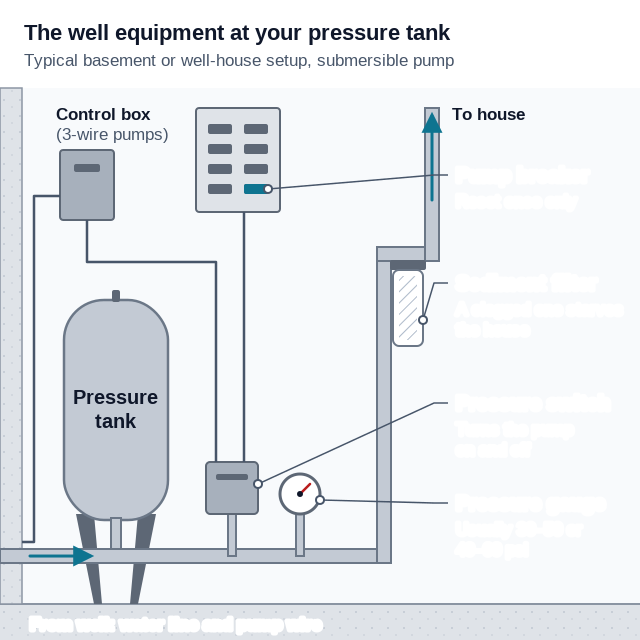
- Pressure gauge: write down what it reads. Zero points to the pump, the pressure switch or the power supply. A reading that is low and still falling points to the pressure tank or a leak.
- Recent storm: if there was lightning nearby, say so when you call. Strikes often damage pumps and control boxes.
- Sediment filter: if you have a whole-house filter, look at the cartridge. A clogged one can starve the house and look exactly like a pump failure.
- Before you call, note the pump's age and the well depth or pump setting if you know them, plus what changed: no water, low pressure, rapid cycling, or air or sand in the water.
Do not do this
- Well pumps run on high-voltage circuits. Don't open the control box or the pressure switch cover unless you know how to work safely on live circuits.
- Reset a tripped pump breaker once, not repeatedly. A breaker that trips again is reporting an electrical fault for a pro to find.
Common causes
No water and the breaker holds: pump, wire, control box or pressure switch
Power is reaching the system but nothing is moving water. A stuck or burned switch contact is one of the most common and cheapest fixes, at $120–$175 installed (Angi). If the pump or its wiring has failed, Angi's typical repair bill is $373–$1,624 (avg $974), and a full replacement runs $973–$2,822.
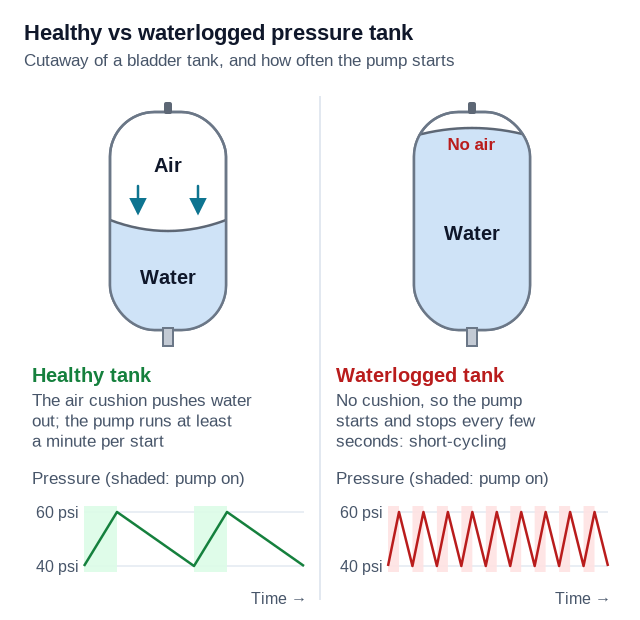
Pump turns on and off rapidly: waterlogged pressure tank
Once the tank loses its air cushion, the pump starts and stops every few seconds of use. A new tank is $300–$700 installed per Angi, or $800–$1,500 per HomeGuide, which prices a different mix of jobs. Our cycle test can confirm it before anyone quotes a pump.
Low pressure: switch setting, clogged filter or a worn pump
Rule out the filter first. A pressure switch that is set low or worn out is a $120–$175 replacement (Angi). A pump that can no longer reach its cut-out pressure is the bigger job.
Air spitting from the taps: low water level or a pipe leak
Air in the lines usually means the pump is drawing the well down or pulling air in through a leak. This one needs a diagnosis before any part is priced; Angi puts the house call at $100–$150.
Sandy or muddy water: pump set too low or a failing screen
Sand wears a pump quickly and shortens its life. Again, diagnosis comes first, starting from the same $100–$150 house call (Angi).
What it typically costs
Most no-water calls start with a $100–$150 house call (Angi, Sep 2026). From there, a pressure switch is $120–$175, a pressure tank $300–$700 (Angi) or $800–$1,500 (HomeGuide), and a typical repair $373–$1,624 (avg $974). A full pump replacement runs $973–$2,822 (avg $1,897, Angi, Aug 2026). After hours, repair labor goes from about $50/hr to $100/hr, plus a $150–$300 surcharge.
Frequently Asked Questions
What should I check first when my well has no water?
The breaker, then the pressure gauge. Reset a tripped breaker once. A gauge at zero points to the pump, switch or power; a low, falling reading points to the tank or a leak.
Can a clogged filter look like a dead well pump?
Yes. A clogged sediment filter restricts flow to the whole house, so the taps run weak or dry even though the pump is working. Check the cartridge before you call.
How often should I check and test my well?
At least once a year, per the CDC. Look the well over each spring for mechanical problems, and have the water tested for total coliform bacteria, nitrates, total dissolved solids and pH.
Should I test the water after a pump repair?
Yes. The CDC advises testing again after any part of the well system is repaired or replaced. Many contractors also recommend disinfecting the well after it has been opened, then testing for bacteria.
The service that handles this
Guidance only — independent local providers assess and price their own work. Last reviewed 2026-10.
Sources for the cost figures
- Angi — Well Pump Repair Cost (Sep 15, 2026) (third-party estimate)
- Angi — Well Pump Replacement Cost (Aug 31, 2026) (third-party estimate)
- Angi — Pressure Tank Replacement Cost (Sep 18, 2026) (third-party estimate)
- HomeGuide — Cost to Replace a Well Pressure Tank (Jul 25, 2025) (third-party estimate)
- CDC — Guidelines for Testing Well Water
Prefer to just talk to someone?
Send the short form — we'll route you to an independent local pro.