Well Pump Repair in North Carolina, NC
Well pump repair typically runs $373–$1,624 nationally, per our cost guide. Independent local pros serving Union County, Johnston County, Franklin County and nearby areas. Describe the problem and we'll route your request — free, no obligation.
- Repair typically $373–$1,624, avg $974 (Angi, Sep 2026)
- Replacement $973–$2,822, avg $1,897 (Angi, Aug 2026)
- Free quotes from licensed local well contractors
Fast response from independent local providers. No obligation.
Typical national cost$373 – $1,624Cost guide →Local Help in North Carolina, NC
In North Carolina the state writes the well standards and the counties enforce them for private drinking water wells. G.S. 87-87 directs the Environmental Management Commission to adopt rules on the location, construction, repair and abandonment of wells and on the installation and repair of pumps and pumping equipment; those rules are in 15A NCAC 02C. Under G.S. 87-97(a), every county, through the local health department serving it, must carry out a private drinking water well permitting, inspection and testing program and enforce the minimum construction, permitting, inspection, repair and testing requirements of the Well Construction Act and its rules. The exception is a private drinking water well with a designed capacity of 100,000 gallons per day or more, or one to be built in an area where the Commission has found prior permission necessary: G.S. 87-88(a) puts those under the Commission's permitting and inspection instead of the health department's.
Replacing a pump or tank is the case the statute singles out. G.S. 87-97(c) says a repair permit is not required for repair work on a private drinking water well that involves only the repair or replacement of a pump or tank, or for maintenance that does not break or open the well seal, and Rule 02C .0304(a) treats disinfection under Rule .0111 as maintenance with no repair permit. Jobs that go further, such as changing casing depth, deepening or redeveloping the well, or anything else G.S. 87-85(12) lists as a repair, need the local health department's repair permit before they start (G.S. 87-97(b)(2)).
North Carolina Service Details
What providers in this area actually see: coverage, common jobs, local pricing factors, and rules worth knowing.
Service Area Notes
- Union County, Johnston County and Franklin County each have a page on this site that covers its own health department's well program, local rules and fees; local requirements can go beyond the state minimums, so read the county page before relying on this summary.
- Statewide paperwork: G.S. 87-97(a1) requires local well programs to use the standard forms the Department created for all required submittals and bars them from creating their own.
- Monroe (Union County) and Smithfield (Johnston County) are named because each has a row under that county in the Census Bureau's 2020 North Carolina place-by-county file.
Common Jobs in North Carolina
- Replacing a submersible or jet pump, or a pressure tank, inside the G.S. 87-97(c) exception
- Disinfecting the well afterward: Rule 02C .0111(a) puts that duty on any person installing a pump in a water supply well, and Rule .0301(b) applies the Section .0100 rules, .0111 among them, to private drinking water wells
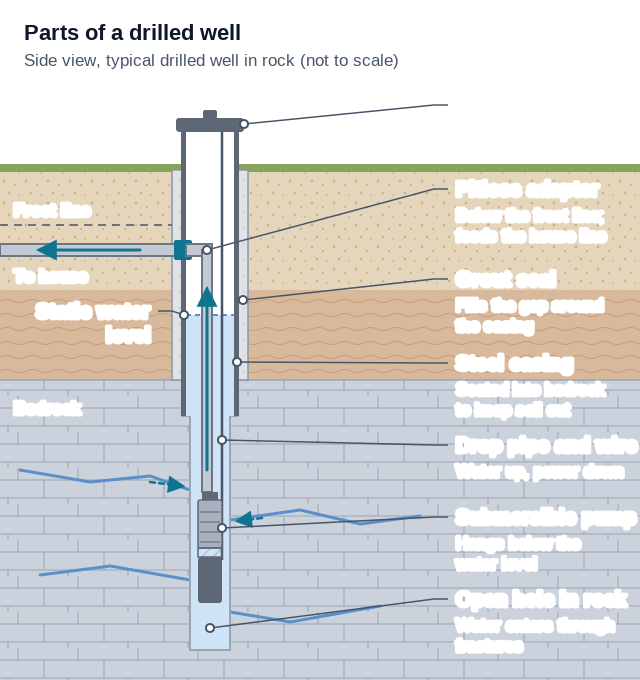
- Fitting the threadless sampling tap that Rule .0109(f) requires of the person installing a pump in a water supply well; the rule sets its location for suction, offset jet and pitless adapter installations, its height and downward orientation, and a backflow preventer or vacuum breaker on any threaded hose bibb also at the wellhead
- Attaching the pump installation information plate described in Rule .0107(j)(3)
- Wiring from the pump to the pressure switch and piping from the well to the tank, which G.S. 87-97(b2) deems authorized by a well permit when a certified well contractor does it, including both in a single ditch as deep as the greater of the two minimum cover requirements, covered by a certified well contractor afterward
What Drives Pricing Here
- Permit or no permit. A permitted repair brings a health department inspection, and G.S. 87-97(g) bars returning a repaired well to service until the department issues a certificate of completion. The department has 30 days from receiving a construction or repair application to issue a permit or a denial; only if it fails to act within those 30 days does the permit issue automatically, and the department may then challenge it under Chapter 150B (G.S. 87-97(e)).
- County charges: each health department sets its own, so no statewide amounts are quoted here; the Union, Johnston and Franklin pages describe what each county publishes.
- Choosing the pump: Rule .0109(a) wants pumping capacity consistent with both the intended use and the yield characteristics of the well, and .0109(b) wants the pump and related equipment located to permit easy access and removal for repair and maintenance.
- Wellhead fittings that come with the job: a screened vent for pressure changes unless a suction lift pump or single-pipe jet pump is used or artesian flowing conditions are encountered (.0109(e)), a priming tee with offset jet pumps (.0109(g)), a pump base plate designed to form a watertight seal with the casing or pump foundation when the pump sits directly over the well (.0109(c)), and a watertight seal on the annular space between the casing and the pump intake or discharge piping when it does not (.0109(d)).
- Wellhead height: under Rule .0112(f) no well may be repaired or altered so the wellhead ends up less than 12 inches above land surface, and grout dug out during a repair has to be replaced as Rule .0107(f) directs.
Permits & Local Rules
- Certification: G.S. 87-98.4(a) bars anyone from performing, managing or supervising well contractor activity, defined in 87-98.2(6) as constructing, installing, repairing, altering or abandoning any well, without certification. A person who is not certified, or is not employed by a certified well contractor, may not offer to do that work unless the person uses a certified well contractor and, before the work, discloses to the landowner in writing that contractor's name and certification number and the name of the company employing the contractor.
- Exemptions in G.S. 87-98.4(b) that bear on pump work include a person employed by, or performing labor or services for, a certified well contractor on activity done under that contractor's personal supervision; a person who constructs, repairs or abandons a well on land that person owns or leases; and a government employee working solely within the scope of that employment. The full list also covers dewatering, mining-related, oil and gas and other activities, plus the licensed-plumber exemption described in the FAQs below.
- Certification levels: the NC DHHS chart lists pump installation and installing other equipment in a well, breaking the well seal for activities such as pump repair, well chlorination, disinfection and down-hole camera work as Level D activities; Level C adds grouting, well abandonment, rehabilitation for biofouling, well development, packer and liner installations and extending casing above land surface. DHHS's certification FAQ says any activity other than breaking the well seal or disinfecting, such as extending casing, needs Level C or higher.
- Disinfection, Rule .0111(b)(1): hypochlorite in sufficient quantity for a chlorine residual of at least 100 ppm, confirmed with chlorine test strips or another quantitative method; no stabilized chlorine tablets or hypochlorite products containing fungicides, algaecides or other disinfectants; granular hypochlorite dropped in the top of the well, or solution placed at the bottom by bailer or through drill rod, hose or pipe that is then flushed; the water agitated or circulated; casing, pump column and other equipment above the water rinsed with the solution; at least 24 hours of standing time; and pumping until no total chlorine residual is detectable before use. Other materials or methods at least as effective need the Department's prior approval on a written request (.0111(b)(2)).
- Records and notices: Rule .0307(a) has any person completing, abandoning or repairing any well submit a record of the work to the local health department and the Division of Water Resources within 30 days of completion, on a Department of Environmental Quality form. Under Rule .0301(b)(3), a well acting as a source or channel of contamination must be repaired or permanently abandoned within 30 days of receipt of notice from the local health department.
- Electrical work: G.S. 87-43.1(10) exempts from the electrical contractor licensing article the installation, construction, maintenance or repair of electrical wiring, devices, appliances or equipment by a certified well contractor running wires from the well pump to the pressure switch.
Local Conditions
- USGS Ground Water Atlas chapter HA 730-L (Henry Trapp, Jr. and Marilee A. Horn, published 1997) puts the Coastal Plain at as much as 140 miles wide in North Carolina and describes it as mostly underlain by semiconsolidated to unconsolidated silt, clay and sand, with some gravel and lignite, in layers that dip gently toward the ocean.
- The atlas calls the boundary between the Coastal Plain and the Piedmont the Fall Line, for the falls and rapids that commonly form where streams cross from the Piedmont's consolidated rocks onto the soft Coastal Plain sediments. It adds that some consolidated rocks, particularly those under the Piedmont and Blue Ridge, are covered with regolith, unconsolidated material largely derived from weathering of those rocks.
- NC DHHS recommends testing well water after repairs or replacements to any well component and after flooding, since contaminants may enter when the well is opened or the wellhead is under water. Its routine schedule is total and fecal coliform bacteria every year, heavy metals, nitrates, nitrites, lead and copper every two years, and pesticides and volatile organic compounds every five years.
- The required test panel in G.S. 87-97(h) is written for newly constructed private drinking water wells: within 30 days after issuing the certificate of completion, the local health department tests the water, or ensures a certified laboratory samples and tests it, for the parameters that subsection lists.
Neighborhoods & Suburbs Served
Union County · Johnston County · Franklin County · Monroe · Smithfield
Emergency Response Expectations
If floodwater covered the wellhead, NC DHHS says to test the well water after the flood because contaminants may enter while the wellhead is under water. For urgent work that goes beyond the pump or tank, ask the county health department's well program about a repair permit before the well is opened; the Union, Johnston and Franklin pages link theirs.
North Carolina FAQs
Is a permit needed to replace a well pump in North Carolina?
Not under state law, if the job involves only repairing or replacing the pump or tank: G.S. 87-97(c) and Rule 02C .0304(a) say no repair permit is required. Local health departments enforce the state rules and can have regulations of their own (Johnston County's 2008 well regulations, covered on that page, are one example), so check the county page or the health department before the well is opened, and get a repair permit first for casing, deepening or other work outside the exception.
Can a licensed plumber replace a well pump?
Within G.S. 87-98.4(b)(13). A plumbing contractor licensed under Article 2 of Chapter 87 may install pumps or pumping equipment, install, break or reinstall a well seal in accordance with G.S. 87-85(6), or disinfect a well incident to installing, altering or replacing pumps or pumping equipment within or near a well. The plumber must keep documentation of a continuing education course covering well seal installation, protection and sanitation attended within the two years before the work, and must remain on site while the work is performed until the well is disinfected and sealed. DHHS says well contractor activities beyond that scope require certification.
Can I replace the pump in my own well myself?
G.S. 87-98.4(b)(2) exempts from certification a person who constructs, repairs or abandons a well located on land that person owns or leases. The NC DHHS certification FAQ words it as installing, repairing or abandoning wells on your own property for your own personal use, and adds that those wells must still meet all State and local well construction standards. Ask the DHHS certification program or your county health department if your situation does not fit either wording.
What information goes on the pump plate?
Rule .0107(j)(3) requires a plate of durable, waterproof, rustproof metal or other Department-approved material, permanently attached within 72 hours after the pump installation to the aboveground casing, the surface grout pad or the enclosure floor if present, visible and not obscuring the well's identification plate. It shows the well contractor and certification number of the person who installed the pump, the date of installation, the depth of the pump intake and the pump's horsepower rating, and it may not be removed.
Sources
- N.C. General Assembly: G.S. 87-97
- N.C. General Assembly: Chapter 87, Article 7 (Well Construction Act)
- N.C. General Assembly: Chapter 87, Article 7A (well contractor certification)
- N.C. General Assembly: G.S. 87-43.1
- NC OAH: 15A NCAC 02C (well construction standards)
- NC DHHS: Well contractor certification levels
- NC DHHS: Well contractor certification FAQ
- NC DHHS: Private well water FAQs
- USGS HA 730-L (1997): Regional summary
- Census Bureau: 2020 North Carolina places by county
Last reviewed 2026-11-11
Counties in North Carolina
Services Available in North Carolina
Well Pump Repair
Well pump repair typically costs $373–$1,624 (avg $974, Angi). Most calls are above-ground fixes: pressure switch, capacitor, control box, or pressure tank.
Learn more →Well Pump Replacement
Well pump replacement typically costs $973–$2,822 (avg $1,897, Angi). Deep wells with submersible pumps cost more than shallow wells with jet pumps.
Learn more →Pressure Tank Replacement
Pressure tank replacement typically costs $300–$700 (avg $500, Angi); HomeGuide puts it at $800–$1,500. A waterlogged tank causes the pump to short-cycle, which shortens pump life.
Learn more →Pressure Switch & Control Box Repair
Pressure switch replacement costs $120–$175; control box replacement $200–$500. These are the most common well pump fixes.
Learn more →Free Tools Before You Call
Ballpark the cost or narrow down the problem before talking to a North Carolina provider.
Need help in North Carolina, NC?
Send the short form — urgent requests get priority routing.