Well Pump Repair in Texas, TX
Well pump repair typically runs $373–$1,624 nationally, per our cost guide. Independent local pros serving Parker County, Weatherford, Aledo and nearby areas. Describe the problem and we'll route your request — free, no obligation.
- Repair typically $373–$1,624, avg $974 (Angi, Sep 2026)
- Replacement $973–$2,822, avg $1,897 (Angi, Aug 2026)
- Free quotes from licensed local well contractors
Fast response from independent local providers. No obligation.
Typical national cost$373 – $1,624Cost guide →Local Help in Texas, TX
Chapter 1902 of the Texas Occupations Code governs water well pump installers. It says a person may not act or offer to act as an installer unless the person holds a license issued by the executive director of the Texas Department of Licensing and Regulation (TDLR) under the chapter's rules (section 1902.151), and an installer must install or repair pumps under standards and procedures the Texas Commission of Licensing and Regulation adopts with the advice of the Texas Water Well Drillers Advisory Board (section 1902.251). Those standards sit in 16 TAC chapter 76. TDLR's program page says a license is required to drill a water-related well in Texas and to install a pump for a water-related well. Under section 1902.001(8), pump installation includes the construction involved in making the well and establishing seals and safeguards as necessary to protect the water from contamination, and repairs to an existing pump.
Registration and local well rules come from groundwater conservation districts under Water Code chapter 36. Section 36.117(h) requires a district to make the owner of a water well register it under district rules and equip and maintain it to conform to the district's rules on casing, pipe and fittings that prevent groundwater from escaping to a reservoir not containing groundwater and prevent pollution or harmful alteration of the water in any groundwater reservoir. Except as the rest of that section provides, section 36.117(b)(1) has districts exempt from their permit requirement the drilling or operating of a well used solely for domestic use or for livestock or poultry if it is on a tract larger than 10 acres and drilled, completed or equipped so that it cannot produce more than 25,000 gallons of groundwater a day; subsection (a) lets a district add exemptions by rule. Each district writes its own rules, so ask the district for the well before a larger pump or a new use goes in.
Texas Service Details
What providers in this area actually see: coverage, common jobs, local pricing factors, and rules worth knowing.
Service Area Notes
- Parker County is this site's only Texas county page, and it covers the rules of the groundwater district for that county, including when a pump change needs district approval.
- Cities named here are incorporated places listed under Parker County in the Census Bureau's 2020 Texas place-by-county file: Weatherford, Aledo, Willow Park, and Springtown, which the same file also lists under Wise County.
- TDLR's Water Well Drillers and Pump Installers program issues and renews the licenses described here; TWDB's groundwater conservation district pages list each district's enabling legislation and management plan.
Common Jobs in Texas
- Submersible or jet pump replacement by a TDLR-licensed pump installer, or by an owner within the exemption in section 1902.001(5) and 16 TAC 76.30(3)
- Disinfecting the well after any pump repair or installation, which 16 TAC 76.108(b)-(c) requires of the licensed installer
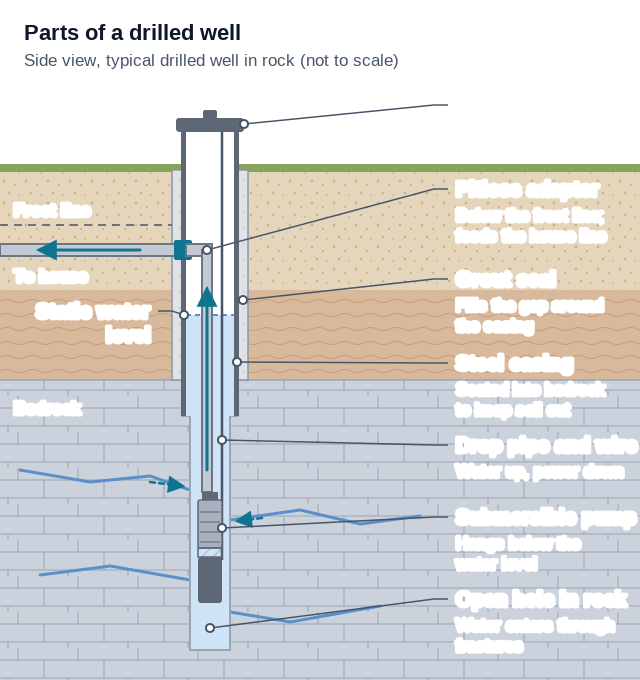
- Making sure that, except as the chapter provides, no unprotected openings into the interior of the pump or well casing remain (76.108(e)): a power driven pump attaches to the casing or an approved suction or discharge line by a closed, sealed connection, and a hand pump, hand pump head, stand or similar device needs a check valve; the closed-connection requirement does not apply to sucker rod pumps, windmills or hand pumps (76.108(f))
- Pressure tank, pressure switch and control replacement
- Plugging or capping an abandoned or deteriorated well found on the property, under 16 TAC 76.104
What Drives Pricing Here
- District approvals: under Water Code 36.117(d), a district may cancel an exemption and require an operating permit for, or restrict production from, a well and assess any appropriate fees if water exempted under (b)(1) is no longer used solely for domestic use or for livestock or poultry, and section 36.117(j) says that exemption does not apply where the water supplies a subdivision needing plat approval under Local Government Code chapter 232. District fees are set locally, so no amounts are quoted here.
- Bad water found during the job: section 1902.252 requires an installer who encounters water injurious to vegetation, land or other water to notify TDLR and the landowner or person having the pump installed or repaired, and to repair or properly complete the well under the commission's standards and procedures to avoid injury or pollution.
- Old wells: under section 1902.253, an installer who knows of an abandoned or deteriorated well as defined in section 1901.255 must tell the landowner or person possessing it that the well must be plugged or capped to avoid injury or pollution. Section 1901.255(c) gives that landowner or possessor until the 180th day after learning of the condition to have it plugged or capped under the commission's standards.
- Oilfield materials: 16 TAC 76.108(d) bars an installer from placing in a well any material that has been used in the production of oil or gas.
Permits & Local Rules
- Owner and helper exemptions: section 1902.001(5) leaves out of the term installer a person who installs or repairs well pumps and equipment on the person's own property for the person's own use, and a person who assists in pump installation under the direct supervision of an installer and is not primarily responsible for the installation. 16 TAC 76.30(3) extends the owner exemption to property the person has leased or rented, for the person's own use. Section 1902.161 separately exempts installing or repairing well pumps and equipment that remove water to construct a highway, road, bridge, drainage or underground utility project. The Parker County page shows one district's own rule on licensed work, so ask the district before relying on the state exemption.
- Disinfection, 16 TAC 76.108: during any pump repair or installation the licensed installer must make a reasonable effort to maintain the integrity of groundwater and prevent contamination by elevating the pump column and fittings or other means suitable under the circumstances. The installer then disinfects the well by treating the water in the casing to an average disinfectant residual of 50 mg/l for the entire volume of water in the casing, circulating the disinfected water in the casing and pump column to the extent possible, and pumping the well for at least 15 minutes to remove it; the disinfectant goes into the open casing or through the well vent, is allowed to dissolve as its manufacturer specifies, and the well is then flushed.
- When a well counts as in use: section 1901.255(a) treats a well as in use, rather than abandoned, if it is not deteriorated and contains the casing, pump and pump column in good condition; if it is not deteriorated and has been capped; if its water has been put to an authorized beneficial use under the Water Code; if it is used in the normal course and scope and with the intensity and frequency of other similar users in the community; or if the owner participates in the Conservation Reserve Program or a similar governmental program. A deteriorated well is one that, because of its condition, will cause or is likely to cause pollution of any water in the state.
- Plugging and capping methods: 16 TAC 76.104(d) says a non-deteriorated well that contains casing in good condition and is beneficial to the landowner can be capped with a covering that keeps surface pollutants out, can sustain at least 400 pounds and cannot easily be removed by hand; plugging follows the methods and material limits in 76.104(a)-(c), by a licensee or well owner and in compliance with local groundwater conservation district rules or incorporated city ordinances, and under 76.104(e) any licensee or landowner can remove the pump to plug a well. Section 1901.255(d) requires a driller, licensed pump installer or well owner who plugs an abandoned or deteriorated well to submit a plugging report within 30 days to the groundwater conservation district, if the well is in one, and to TDLR's executive director.
- Apprentices: section 1902.153 directs the commission to establish an apprentice pump installer program by rule.
Local Conditions
- TWDB recognizes 9 major aquifers, which produce large amounts of water over large areas, and 22 minor aquifers, which produce minor amounts over large areas or large amounts over small areas. Its aquifers page says these aquifers supplied 55 percent of the 14.7 million acre-feet of water used in the state in 2020.
- The same page explains that an aquifer's outcrop, where its host formations are exposed at land surface, corresponds to its principal recharge zone, and that groundwater there is normally under unconfined, water-table conditions and is most susceptible to contamination.
Neighborhoods & Suburbs Served
Parker County · Weatherford · Aledo · Willow Park · Springtown
Emergency Response Expectations
After recent flooding or a loss of water pressure, TCEQ's GI-433 says having the water tested by an accredited lab for total coliform and E. coli is the first step to finding out whether the well is contaminated. For license questions, use TDLR's Water Well Drillers and Pump Installers program; for district registration or notice rules on an urgent pump change, contact the groundwater conservation district for the well.
Texas FAQs
Does Texas require a license to replace a well pump?
For anyone acting or offering to act as an installer, yes (Occupations Code 1902.151). Owners working on their own, leased or rented property for their own use are outside the definition of installer, as are helpers assisting under an installer's direct supervision who are not primarily responsible for the installation, and dewatering pumps for the construction projects named in section 1902.161 are exempt. A groundwater district can have its own rules, so check with the district too.
Who issues permits for work on a Texas water well?
The state statutes summarized here deal with who does pump work and how; registration, permits and local well rules come from the groundwater conservation district, where one covers the well, under Water Code chapter 36. Ask that district before changing a pump's capacity or the well's use, and use TWDB's district pages to find it.
How should a well be disinfected after a pump is replaced?
16 TAC 76.108 has the licensed installer bring the water in the casing to an average disinfectant residual of 50 mg/l, circulate it through the casing and pump column as far as possible, and pump the well for at least 15 minutes, putting the disinfectant in through the open casing or well vent and letting it dissolve per the manufacturer before flushing.
How do I check the water for bacteria after pump work?
TCEQ's GI-433 says to get a lab-provided sterile container and form, collect the sample as the guide describes, and get it to the lab quickly, since the sample must be tested within 30 hours after it is collected. If the lab finds total coliform, the guide says not to use the water for drinking, bathing, cooking, preparing food, making ice, washing dishes or cleaning; to boil or disinfect it before use, or use bottled water or another source, until a test shows total coliform absent; and to disinfect the well and repeat the test.
Sources
- Texas Occupations Code ch. 1902: Water Well Pump Installers
- Texas Occupations Code ch. 1901 (Sec. 1901.255)
- Texas Water Code ch. 36 (Sec. 36.117)
- 16 TAC 76.30: Exemptions
- 16 TAC 76.104: Plugging and capping
- 16 TAC 76.108: Technical Requirements--Pump Installation
- TDLR: Water Well Drillers and Pump Installers
- TWDB: Texas Aquifers
- TWDB: Groundwater Conservation Districts
- TCEQ GI-433 (revised June 2023): Sampling a private well for microbial contaminants
- Census Bureau: 2020 Texas places by county
Last reviewed 2026-11-11
Counties in Texas
Services Available in Texas
Well Pump Repair
Well pump repair typically costs $373–$1,624 (avg $974, Angi). Most calls are above-ground fixes: pressure switch, capacitor, control box, or pressure tank.
Learn more →Well Pump Replacement
Well pump replacement typically costs $973–$2,822 (avg $1,897, Angi). Deep wells with submersible pumps cost more than shallow wells with jet pumps.
Learn more →Pressure Tank Replacement
Pressure tank replacement typically costs $300–$700 (avg $500, Angi); HomeGuide puts it at $800–$1,500. A waterlogged tank causes the pump to short-cycle, which shortens pump life.
Learn more →Pressure Switch & Control Box Repair
Pressure switch replacement costs $120–$175; control box replacement $200–$500. These are the most common well pump fixes.
Learn more →Free Tools Before You Call
Ballpark the cost or narrow down the problem before talking to a Texas provider.
Need help in Texas, TX?
Send the short form — urgent requests get priority routing.